
Top Things to Do in Norway
12 must-see attractions and experiences
Norway pays off for travelers who show up with no fixed plan and a real hunger to move through the land. Granite cliffs drop straight into water so cold it looks ink-dark from above. Summer light hangs past midnight and drenches the western fjords in a glow you will not find elsewhere in Europe. Winter brings total darkness broken only by green and violet curtains that appear overhead and vanish without warning. Accept the scale first: the country runs from the latitude of the Shetland Islands to the edge of the Arctic Ocean, distances between major sites are vast, and Norwegians prize silence and outdoor time over the kind of staged tourism common elsewhere. The regions differ sharply. The western fjords, Lysefjord, Sognefjord, Hardangerfjord, slash inland with brute force, their dark walls rising in granite and schist bands streaked white where waterfalls fall. Central Norway opens into high plateaus where the air smells of lichen and snowmelt, and reindeer cross roads at dawn without bothering to look. The far north gives you raw Arctic edge: salt wind, unbroken sky, and the strange weight of standing at Norway's northern tip with nothing ahead but open ocean. Oslo, the capital, is quietly confident, with excellent seafood, compact museums, and an unhurried street culture that mirrors the national ease with city life. First-timers often misjudge the physical effort Norway demands. The famous viewpoints above Lysefjord require real hiking on uneven ground. Waterfalls like Vøringsfossen and Låtefossen are best reached on foot, through cold mist and the low roar that you feel in your chest. Even the Flåm Railway descent rewards those who sit still and watch the landscape shift every few minutes as the smell of altitude gives way to the smell of the fjord. Norway gives more to visitors who move actively and without hurry. Your pace shapes every experience.
Hand-Picked Experiences in Norway
The best of every kind, whatever you're in the mood for
On the Water
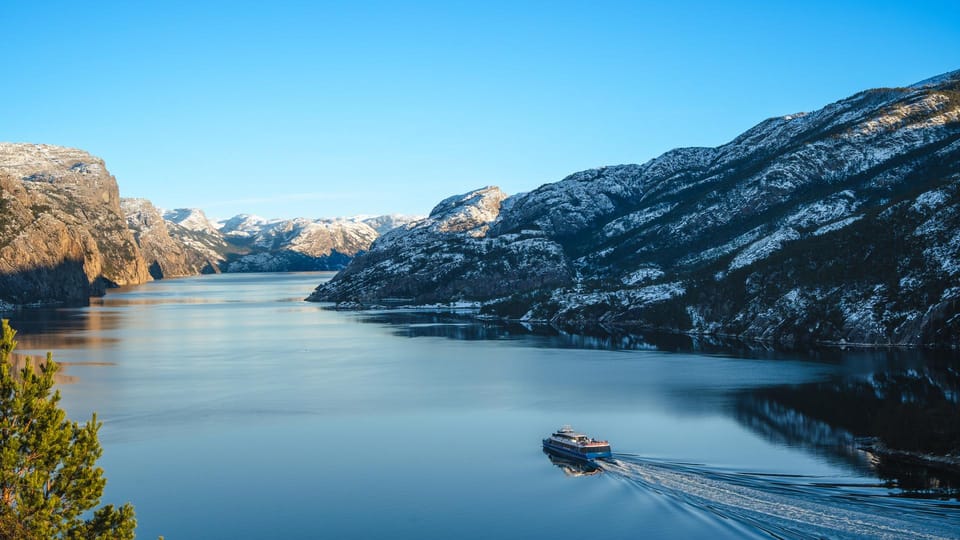
Electric Fjord Cruise to Lysefjord and Preikestolen
Sail silently aboard an eco-friendly electric fjord cruise to Lysefjord and Preikestolen.
Insider tip Sail silently aboard an eco-friendly boat
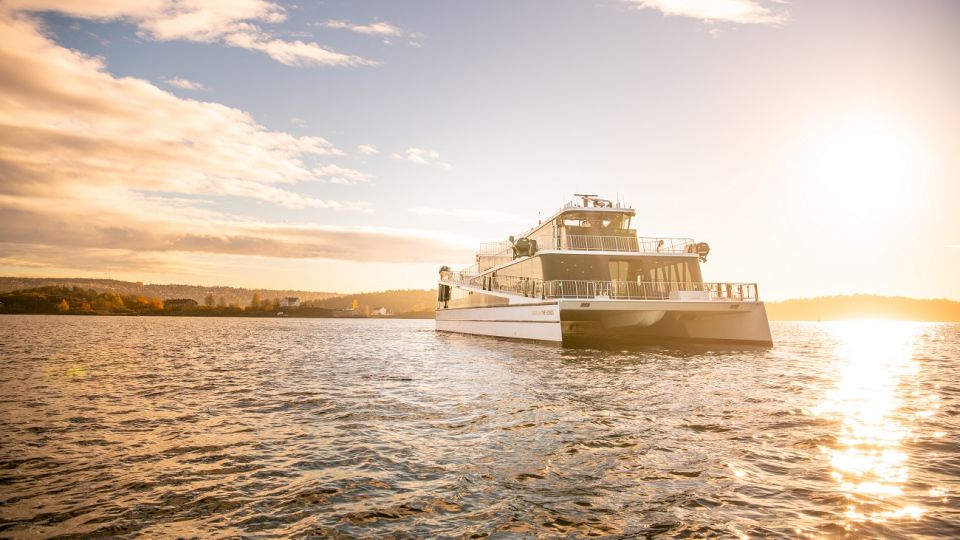
Scenic Fjord Cruise with Audio Guide Commentary
Cruise · rated 4.5 from 5,560 reviews · from $44
Insider tip explore the inner parts of Oslofjord on an electric ship

Oslo Nature Walks: Island Hopping Tour
Discover excellent coastal scenery on an Oslo nature walks island hopping tour.
More to Explore
Even more of the best of Norway
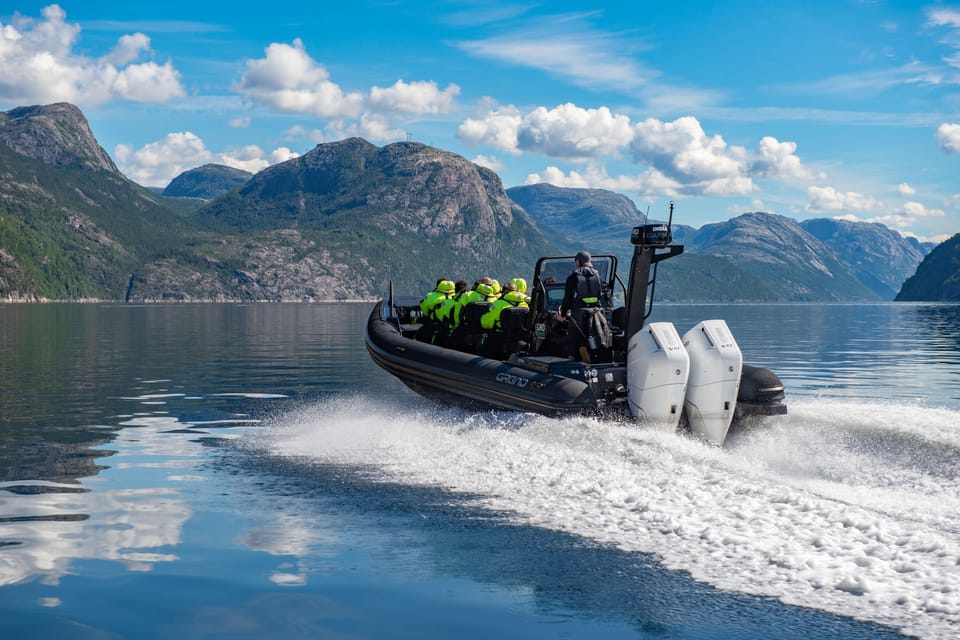
RIB Tour to Lysefjord
Guided ExperienceA rigid inflatable boat approaches the Lysefjord cliff faces at speed, making the fjord feel like a different entity from anything on a large cruise vessel, the hull bouncing through chop, cold salt air sharp against the face, rock walls closing in until their color gradations show: gray-brown granite above fading to near-black where moisture clings year-round. At the base of certain waterfalls the guide cuts the engine and the boat drifts in fine spray, the water tasting faintly of mineral and snowmelt, the silence after the engine stops as abrupt as a door closing. This format compresses Lysefjord's scale into an immersive pace.
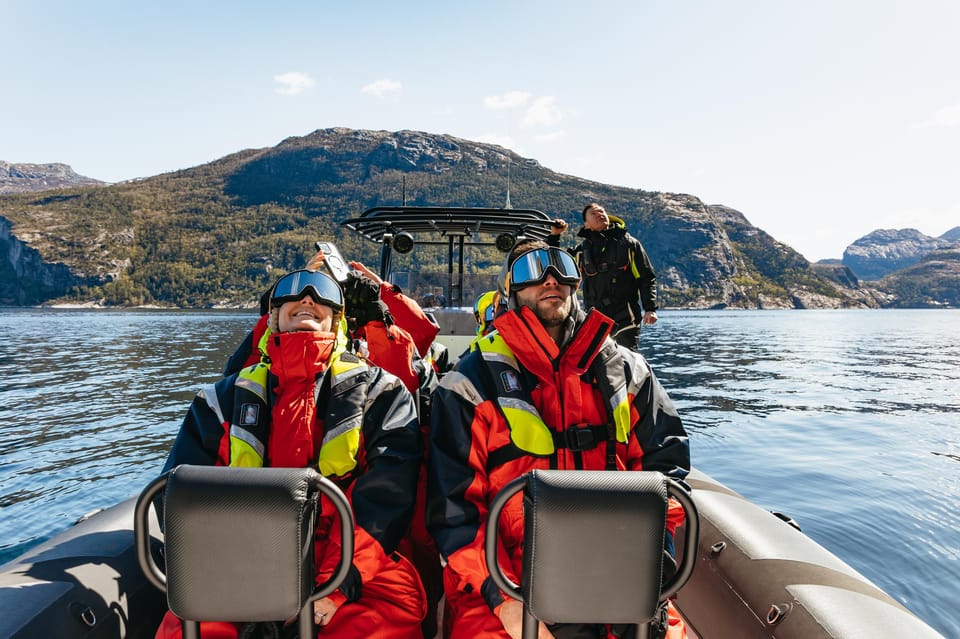
Lysefjorden and Pulpit Rock RIB Boat Tour
CruiseLysefjorden's walls close in fast at RIB speed, the sensation somewhere between exhilarating and disorienting as the boat carves through water that mirrors the cliff faces towering above. This tour includes sustained upward views of Preikestolen, Pulpit Rock, from directly below, a perspective no trail can replicate and one that reveals the full geometry of the ledge jutting hundreds of meters above: less a viewpoint than a geological anomaly balanced over the fjord. Seals occasionally haul themselves onto rocks at the fjord's narrowest points, unbothered by the boat's approach, while cliff-nesting birds spiral overhead against the gray Norwegian sky.
North Cape
Notable AttractionsThe North Cape plateau sits at the top of Magerøya island at Norway's extreme northern latitude, where the Barents Sea stretches away to the horizon in every direction and the wind arrives carrying nothing but Arctic air with no land between it and the polar ice. The famous globe sculpture at the cliff edge has become the standard photograph. But the actual experience of standing there, feeling the cold, salt-heavy air press against your face, hearing nothing but wind and the distant sound of waves far below, is what travelers recall months later. In high summer the midnight sun moves in a low arc that never dips below the horizon. In winter the darkness is total, and the aurora appears overhead as rippling curtains of green and occasionally violet light that shift and fold without explanation.
Flåmsbana
Notable AttractionsThe Flåm Railway descends from the high plateau at Myrdal, where snow lingers even in June and the air carries the smell of cold stone and altitude, down through horseshoe tunnels and past waterfalls that send mist across the train windows on their way to the village of Flåm at sea level. The gradient is steep enough to require specially engineered braking systems, and the train pauses at Kjosfossen waterfall long enough for passengers to step onto an open platform and stand in cold spray while the cascade roars past at close range. The vegetation deepens as the train descends, colors darkening from pale alpine scrub to the deep greens of temperate valley forest, until Flåm appears below and the fjord opens ahead, blue-green and wide.
Vøringsfossen
Notable AttractionsVøringsfossen drops into the Måbødalen canyon in a white column that announces itself as a roar audible long before the falls come into view, the sound arriving through rock and air as a low, constant vibration that builds as the path narrows toward the canyon rim. The mist carries far enough that the rock around the viewpoint is permanently damp and dark with moss, the air noticeably cooler than it was a hundred meters back on the trail, with the smell of cold water and mineral stone that is specific to Norway's highland drainage. The falls are fed by snowmelt from the Hardanger plateau, which means volume peaks in late May and June when the runoff runs copper-brown at the edges from peat bogs above, a warm fringe on the white column visible from the viewpoint and unmistakable.
Låtefossen
Natural WondersLåtefossen is a double waterfall, two separate streams that merge into a single braided column before crossing beneath a stone arch bridge on the road below, making it one of the few Norwegian falls where the main highway runs directly through the cascade's zone of influence. The sound is immediate and unavoidable from the road. Standing on the bridge you feel the constant fine spray on your skin and taste the mineral freshness of water drawn from the Hardanger highlands, while the surrounding valley walls rise dark with wet rock and patchy birch forest whose leaves tremble with the vibration of the falls. Drivers frequently mistake Låtefossen for a roadside footnote on the way to somewhere else and lose an hour they did not plan to spend there.
Stegastein
Notable AttractionsThe Stegastein viewpoint extends out from the cliff face on a cantilevered wooden platform above the Aurlandsfjord, the timber warm underfoot even on cool days and the drop below the glass safety railing a sheer descent of hundreds of meters to the water visible as a thin line far below. The platform was designed to appear to float above the fjord, and from its edge the Aurlandsfjord narrows to a blue-green thread between valley walls, one of Norway's most deliberately composed natural views turned into something close to a geometric proposition. On a clear day the silence at that elevation is broken only by wind and the occasional sound of meltwater running off the mountain above. The only intrusion is the faint smell of treated timber beneath your feet and the occasional distant creak of the platform adjusting to the temperature.
Steinsdalsfossen
Notable AttractionsSteinsdalsfossen has a maintained path running directly behind the cascade, allowing visitors to walk through the curtain of water with the falls roaring a meter away and the sunlit valley framed in the gap between the moving water and the rock face behind you. The path is permanently damp and slippery. The air behind the falls tastes of cold limestone and fresh water, and the sound at that proximity is felt as a physical pressure against the chest and ears rather than processed as distant noise. The surrounding Hardanger landscape, apple orchards in the lower valley, dark birch forest rising on both sides, gives Steinsdalsfossen a pastoral setting unusual for a waterfall of this volume, making the shock of stepping into the cascade's zone all the more abrupt.
Planning Your Visit
Practical tips for getting the most out of Norway
Frequently Asked Questions
Visit Norway Northern Lights?
The best time to see the northern lights in Norway is between late September and late March, with peak viewing from November to February. Tromsø is the most popular base for aurora hunting, though you can also see them from the Lofoten Islands, Alta, and other locations above the Arctic Circle. Tours typically cost 800-1,500 NOK per person. But you can also watch independently from dark locations outside city centers. Remember that sightings depend on solar activity and clear skies, so we recommend staying at least 3-4 nights to increase your chances.
Tourist Spots in Norway?
Norway's most visited attractions include Bergen's Bryggen wharf and Fløyen mountain, the Geirangerfjord (accessible by ferry from May to September), and Preikestolen (Pulpit Rock) near Stavanger. In Oslo, the Viking Ship Museum, Vigeland Sculpture Park, and the Opera House are popular stops. The Atlantic Road, Trolltunga hiking trail, and the Flåm Railway are also frequently visited, though some require advance planning or are seasonal.
Attractions in Sweden?
This is a Norway travel guide, so we focus on Norwegian attractions. If you're planning a Scandinavian trip that includes both countries, the border regions between Norway and Sweden are easily accessible by train or car, and many travelers combine visits to Oslo with Stockholm or Gothenburg.
Visit Sweden?
Visit Finland?
While this is a Norway-focused guide, Finland can be reached from northern Norway through the shared border near Karasjok and Kirkenes. The drive from Tromsø to Rovaniemi, Finland takes about 6-7 hours, making it possible to combine northern Norway with Finnish Lapland in one winter trip.
Explore more experiences in Norway
Browse live availability and pricing.
Didn't see anything interesting yet?
Browse Viator's full catalog of tours, day trips, food experiences, and private guides in Norway.
See All Norway Tours on ViatorReady to plan your trip to Norway?
Now that you've got the research covered, here's where to go next.